The right choice depends on more than the price of a cap, calendar or coaster. Compare fulfilment cost, joining volume, employee needs, storage, personalisation and delivery conditions before deciding whether to issue one assembled pack or manage separate branded items.
Key takeaways
- Choose assembled kits for predictable hiring and consistent onboarding.
- Use separate branded items for remote, staggered, or location-based joining.
- Include only stationery, access items and information employees will use.
- Order in batches that match hiring forecasts to prevent unused stock.
When should you choose an assembled kit instead of separate items?
Choose one assembled kit when joining volumes are predictable, employees receive the same core materials, and most people work from one office or follow the same onboarding process. Choose separate branded items when people join throughout the month, work remotely, report to different Mumbai locations, or need different stationery and identity-card accessories.
| Option | Best fit | Main operational trade-off |
|---|---|---|
| Fixed core kit | Stable joining cohorts and identical contents | One delayed or defective item can hold the entire pack |
| Modular kit | Stable box and stationery with changing policy inserts | Requires version control and separate insert replenishment |
| Separate SKUs | Variable roles, locations, joining dates and item combinations | Allows partial fulfilment but needs stronger pick-and-pack controls |
Compare complete landed cost, not the printed unit price. Include artwork setup, proofing, assembly, quality checks, storage, cartons, dispatch and last-mile delivery; these costs can make a kit more expensive than issuing the same items separately.
A kit creates one fulfilment event, while separate items let you issue available stock and replace only the missing SKU. Build the comparison using:
- Expected annual joining volume
- Number of offices
- Personalisation rate
- Storage period
- Artwork-change frequency
This framework helps you evaluate welcome kits for employees in Mumbai against the workload your HR and facilities teams can handle. A fixed core suits stable demand; modular packing limits obsolete inserts; separate SKUs suit changing employee requirements.
For welcome kits for employees in Mumbai, choose the format that reduces total handling without delaying the employee’s first day.
What should a practical employee welcome kit contain?
A practical pack starts with first-day documents and tools, not promotional merchandise. Include the onboarding letter, joining checklist, access instructions, emergency contacts, policy documents, benefits information, stationery, equipment setup instructions and one useful branded item.
Specify identity-card accessories separately. Record the card dimensions, holder size, lanyard width, clip type and breakaway requirement; a polished kit still fails when the holder or clip does not fit.
- Choose the branded item by role: a notebook and pen suit office staff, while a durable badge holder or role-specific equipment guide may matter more to customer-facing and field teams.
- For custom employee welcome kits in Mumbai, keep the box, folder and core stationery stable. Replenish policy booklets, QR-code cards, location instructions and department inserts as versions change, instead of storing obsolete sealed kits.
- Personalise only for an operational purpose: employee name, department, joining date, location or access identifier. Send that variable data in a version-controlled file with restricted access.
- Use a master packing list that identifies the personalised item for each employee. This catches wrong-name and wrong-department errors before dispatch.
| Role | Useful branded item | Why it earns space |
|---|---|---|
| Office staff | Notebook and pen | Supports meetings and daily notes |
| Customer-facing staff | Durable badge holder | Keeps identification visible and protected |
| Field teams | Role-specific equipment guide | Supports correct use away from the office |
How do kits affect assembly, storage and remote delivery?
A preassembled kit cuts repeated picking during a large intake, but moves the workload earlier into assembly, counting, sealing and quality checks. Define the specification before requesting a quote:
1. List every item, quantity per kit, packing sequence, employee-specific insert, spare percentage, carton configuration and acceptance criteria.
2. Keep a SKU-level inventory record for separate items. Sign a packing checklist for every assembled kit, so missing lanyards, wrong documents and incorrect quantities are traceable.
3. Store paper folders, notebooks, certificates and corrugated boxes off the floor and away from direct moisture during Mumbai’s monsoon. Moisture causes curling, blocking, softened cartons and scuffing; pack printed material only after it has equilibrated to the production area.
4. For remote delivery, validate addresses, specify protective outer packaging, coordinate with the courier and define what happens when a part is damaged or missing. Decide whether HR will send one complete carton or release documents and branded items separately.
5. Record each replacement against the employee and SKU. A defective lanyard should not force a complete-kit remake, and apparel sizes need separate tracking because mixed sizes make preassembly risky.
6. Compare the complete landed cost, including assembly, storage, cartons, dispatch and exception handling. If policy, benefits or access information changes frequently, avoid storing large quantities of sealed kits; modular packing reduces obsolete stock and write-offs.
A separate-item process requires tighter pick-and-pack control, but it suits remote employees and variable requirements. A complete carton simplifies fulfilment only when its contents remain stable.
What should you check before ordering corporate welcome kit printing in Mumbai?
Start with a like-for-like quote. Ask every vendor to price the same item list, quantities, packing sequence, personalisation, spare percentage, carton configuration and acceptance criteria. Separate printing, finishing, assembly, storage and delivery charges so a low unit price does not conceal kitting or exception-handling costs.
1. Require a signed digital proof and one master artwork register. Record the logo, department name, location, joining cohort, QR code and employee name; version-control every change before artwork freeze.
2. Approve production substrates, not only paper proofs. Test laminated cards, PVC or synthetic stickers, coated metal items and plastic accessories for adhesion, rub resistance and QR-code scanability on the actual material.
3. Define colour control in measurable terms. Name the print process and tolerance; use ISO 12647-2 where offset lithographic process control applies. That standard does not guarantee identical appearance across textile, plastic, metal, digital and screen-printed components.
4. Check material quality, packaging strength, assembly accuracy, defect inspection, replacement policy and responsibility for missing items. Confirm whether the quote includes kitting, spares, storage and exception handling; Chintan Graphics and competing suppliers should answer the same checklist.
5. Request dates for artwork freeze, quantity confirmation, proof approval, manufacturing, assembly, dispatch and delivery to each Mumbai location. Ask vendors to build the schedule against your intake date rather than assuming a safe lead time.
6. Compare complete landed cost, including artwork setup, proofing, quality checks, cartons and last-mile delivery. A paper proof cannot predict how a finished accessory will perform.
Related products
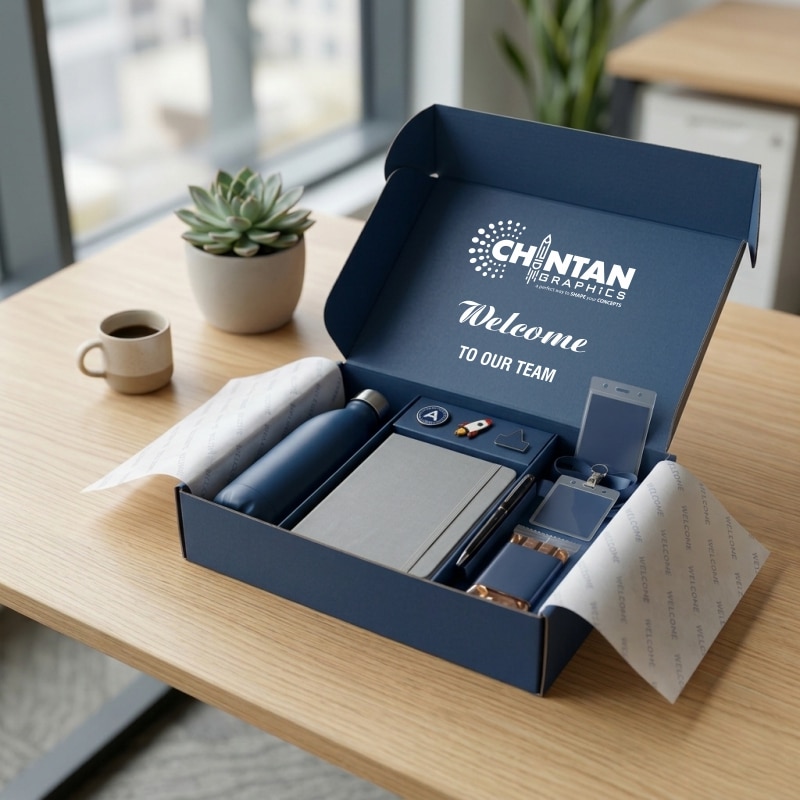 | Customised Printing Service Welcome Kit ₹3500 Welcome your new employees abode with a heart-warming welcome kit. |
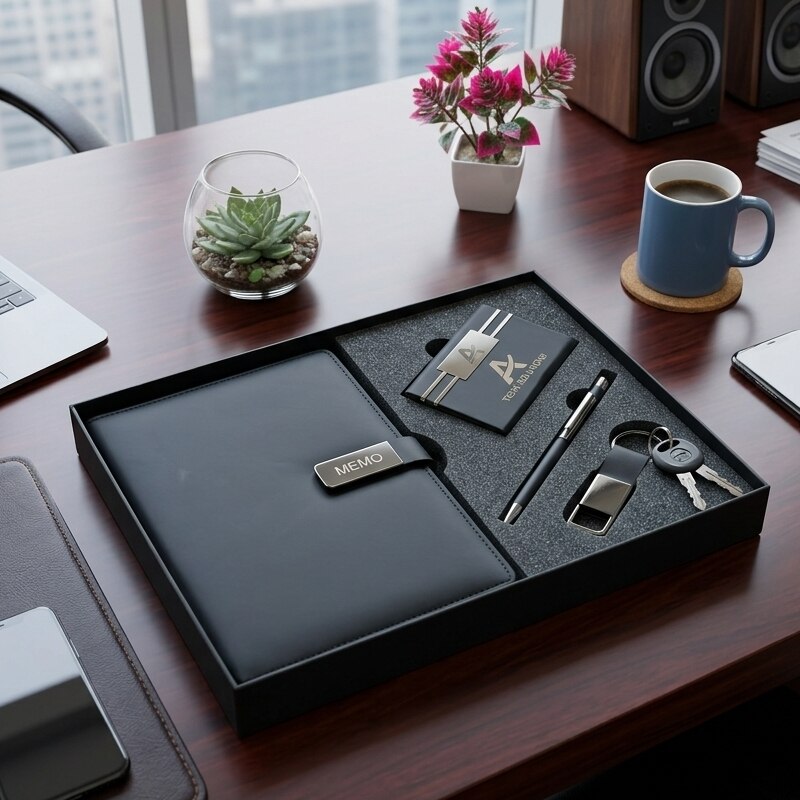 | Customised Printing Service CORPORATE GIFT SET ₹2500 Show Appreciation with Customised Gift Hampers for Staff, Employees and Clients Are you looking for a meaningful way to appreciate your team or thank... |
How can you prevent branded joining kits from becoming unused stock?
Audit each employee group’s first-week routine before choosing branded items. Ask what people carry, display, scan, wear or consult every day, then remove anything without a clear use. A generic cap, coaster or badge can inflate perceived pack value while creating storage and packing work.
Use the format that matches the cohort:
| Format | Best fit | Main stock risk |
|---|---|---|
| Fixed core kit | Predictable bulk intakes with stable contents | Obsolete sealed packs |
| Modular kit | Changing policy, access or benefits inserts | Module version errors |
| Separate branded items | Multiple locations, remote work or varied roles | Pick-and-pack mistakes |
Give office-based staff a compact document-and-stationery pack. Equip customer-facing teams with compatible card holders, clips or lanyards, and provide remote employees with materials that support digital onboarding and home delivery. Keep one standard core across cohorts, then add controlled modules for department, location and work mode.
After every intake, count:
- Unused items
- Incorrect items and replacements
- Damaged cartons
- Failed deliveries
Set a reorder point for each SKU and a write-off rule for obsolete inserts. For branded joining kits in Mumbai, assemble stable contents for predictable bulk intakes, replenish modules when information changes, and issue separate items when employee combinations vary.
The best choice delivers accurate onboarding materials without paying to print, store and ship merchandise that does not support the employee’s work.
Frequently asked questions
When should you choose an assembled kit instead of separate items?
Choose an assembled kit when joining volumes are predictable, employees receive the same core materials, and onboarding follows one office-based process. Choose separate items for staggered, remote, or location-based joining.
What should a practical employee welcome kit contain?
Include items employees will use during their first weeks, such as an onboarding folder, notebook, pen, ID-card holder, lanyard, access instructions and essential company information. Match the contents to each role.
How do kits affect assembly, storage and remote delivery?
Assembled kits require picking, packing and storage space but simplify one-time distribution. Separate items support flexible fulfilment and remote delivery, while requiring more tracking and packaging decisions.
What should you check before ordering corporate welcome kit printing in Mumbai?
Check artwork accuracy, paper and material specifications, print quantities, delivery locations, packing requirements, lead time, proof approval and whether identity-card accessories fit your existing cards.
How can you prevent branded joining kits from becoming unused stock?
Base quantities on a hiring forecast, keep core items standard, avoid role-specific overprinting, reorder in smaller batches and use separate items when joining dates and locations vary.
Related products
 | Multicolor Printing Cap ₹270 Create a professional impression with printed caps. Ideal for corporate events and employee uniforms Adjustable for all sizes. |
 | Multicolor Printing Desk Calendar ₹190 Make a note of your meetings, appointments and other commitments with personalised desk calendars. |
 | Multicolor Printing Tea Coasters ₹359 Get fun and quirky personalised coaster sets for your dining room, bar area, or office cubicles. |
 | Multicolor Printing Bag ₹350 MOQ. 1000 Add branding to any sale, trade fair or corporate event. |
Keywords